Siddhi Vinayak Industries
LED Lighting Knowledge Center

LED Lighting Knowledge Center

Learn Everything About LED Lighting Technology

LED Lighting Knowledge Center

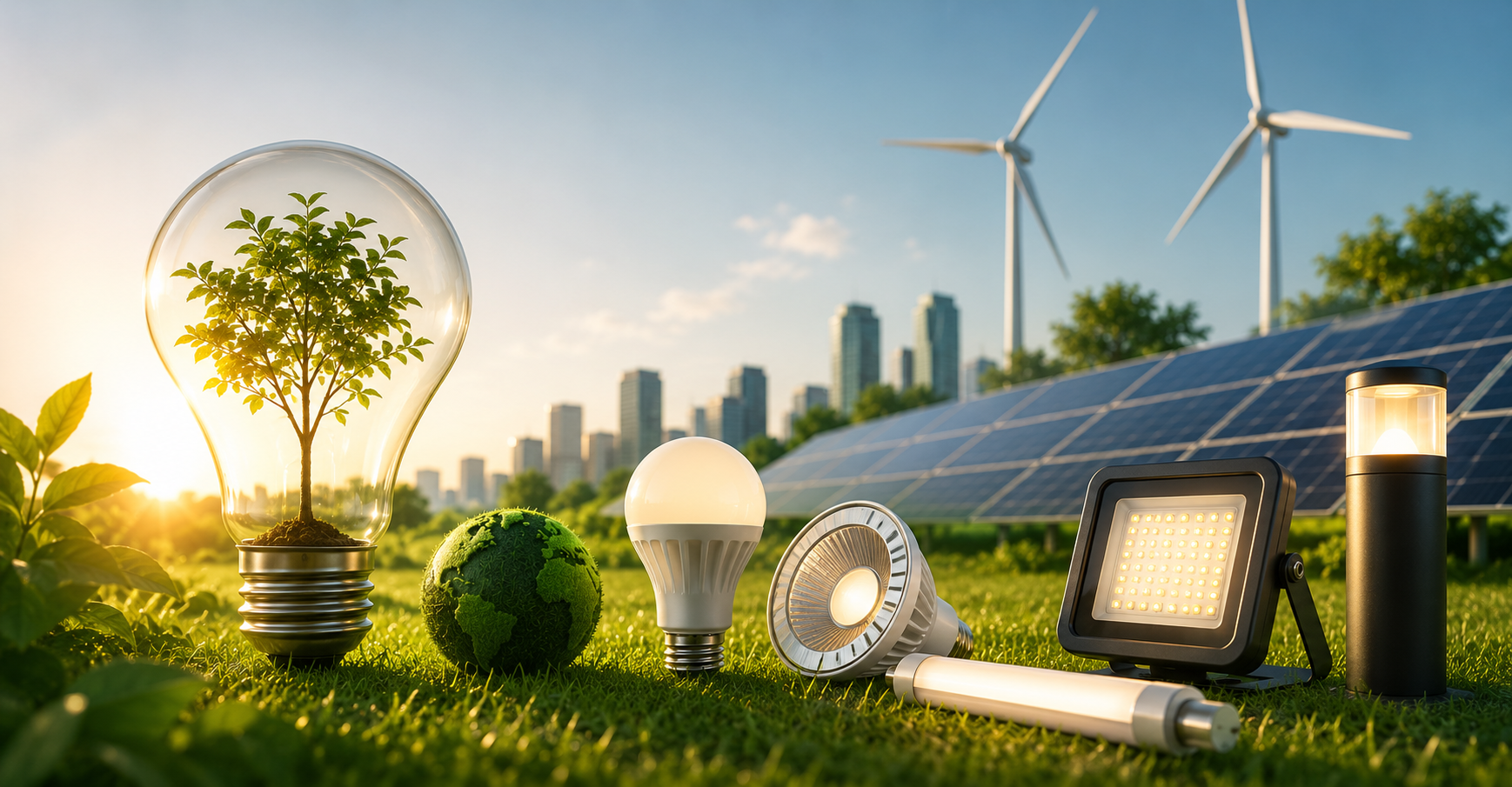
LED (Light Emitting Diode) lighting is one of the most energy-efficient and environmentally friendly lighting technologies available today. It offers longer life, lower power consumption, better illumination, and reduced maintenance costs compared to conventional lighting systems.

This section is designed to educate customers about LED technology and help them make informed decisions.
LED Lighting Dimming

1. What is an LED?

πŸ’‘
LED Technology

LED stands for Light Emitting Diode. It is a semiconductor device that converts electrical energy directly into light.

⚑
Efficient Lighting

LEDs produce light efficiently with minimal heat generation. They are widely used in homes, industries, hospitals, pharmaceutical plants, laboratories, and commercial buildings.

2. How Does an LED Light Work?

Electricity β†’ LED Chip β†’ Driver β†’ Optical Lens/Diffuser β†’ Uniform Light Output

A quality LED luminaire consists of the following key components:

πŸ”†
LED Chips

Primary source of light generation.

πŸ”Œ
Constant Current Driver

Maintains stable current and voltage for reliable operation.

🌑️
Heat Sink

Removes heat efficiently to improve LED lifespan.

πŸ”΅
Diffuser

Provides smooth and uniform light distribution.

🏠
Housing

Protects all internal components from damage.

πŸ›‘οΈ
Surge Protection

Protects the fixture from voltage fluctuations.

πŸ”—
Wiring and Connectors

Ensures reliable electrical connections within the luminaire.

3. Advantages of LED Lighting

80%
Energy Savings
50K+
Hours Life
0
Mercury Content
ON
Instant Start
🌱 Environment Friendly
πŸ’Ž Better Light Quality
πŸ”§ Low Maintenance
🌑️ Lower Heat Generation
πŸ€– Suitable for Smart Controls

5. Understanding Important LED Terms

Watt (W)

Power consumed by the light.

Lumen (lm)

Amount of light produced.

Lux (lx)

Light falling on a surface.

Efficacy (lm/W)

Lumens produced per watt of power.

CCT

Correlated Color Temperature – Warm, Neutral, or Cool White.

CRI

Color Rendering Index – Ability to show true colors.

Beam Angle

The spread angle of light distribution.

Power Factor

Measure of electrical efficiency.

THD

Total Harmonic Distortion – quality of power.

IP Rating

Ingress Protection – dust and water resistance.

IK Rating

Impact resistance rating.

SDCM

Color Consistency of the LED.

UGR

Unified Glare Rating – comfort level of light.

6. How to Select the Right LED Light

Consider these key factors when choosing the right LED luminaire for your application:

🏭
Application
πŸ“
Ceiling Height
πŸ“
Room Dimensions
πŸ’‘
Required Lux Level
πŸ‘·
Working Height
🌍
Environment
⏱️
Operating Hours
πŸ›‘οΈ
Protection Requirements (IP Rating)

7. What is Lux?

Lux is the measure of light falling on a surface. A conference room may require approximately 300–500 lux, while precision work areas may require higher illumination depending on applicable standards and the task being performed.

This simple formula helps customers understand lighting calculations:

Lux = Lumens Γ· Area (mΒ²)

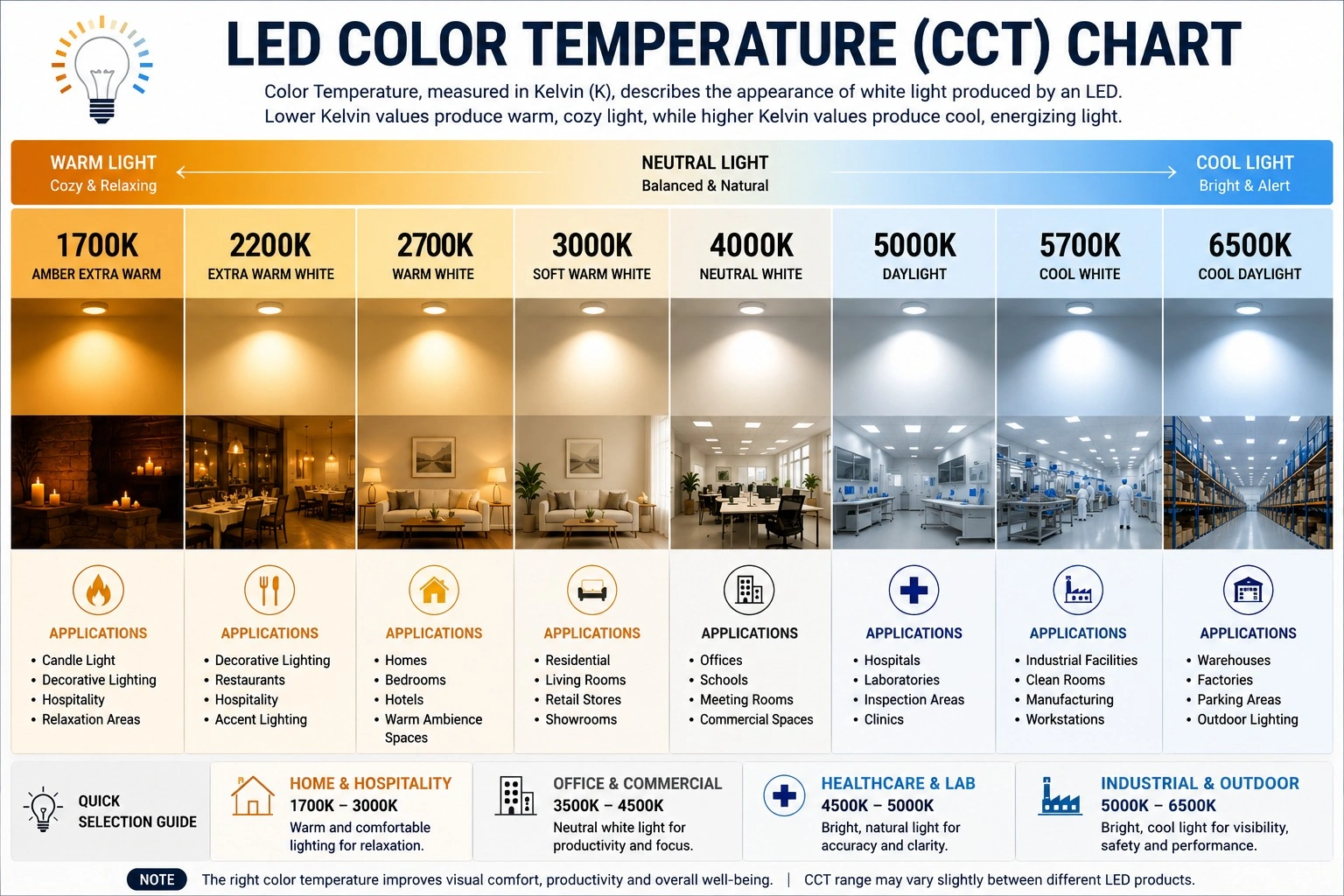
8. Understanding Color Temperature

🟠
1700K – 1800K

Amber Color

🟑
2700K – 3000K

Warm White

βšͺ
4000K

Neutral White

πŸ”΅
5700K – 6500K

Cool White – commonly used in industrial and commercial applications.
LED Color Temperature CCT Chart

9. Why Heat Management is Important

Excessive heat can negatively impact LED performance. Quality heat sink design and proper thermal management are essential for:

⏳
LED Life

Excess heat significantly shortens the operational lifespan of LEDs.

πŸ”†
Light Output

High temperatures cause reduction in lumen output over time.

πŸ”Œ
Driver Reliability

Heat affects driver components leading to early failure.

πŸ“Š
Overall Performance

Thermal mismanagement degrades the complete luminaire performance.

10. Importance of LED Drivers

The driver is often called the heart of an LED light because it:

πŸ”
Regulates Current

Ensures the LED receives consistent and correct current.

πŸ›‘οΈ
Protects LEDs

Guards against voltage spikes and electrical disturbances.

⚑
Improves Efficiency

Optimises power conversion for maximum output.

⏳
Extends Product Life

Stable operation translates to longer luminaire lifespan.

πŸ“ˆ
Stable Performance

Maintains consistent light output throughout operation.

11. Quality Tests for LED Lights

πŸ“‹
LM-79 Performance Testing
πŸ“¦
LM-80 LED Package Testing
πŸ”‹
Electrical Safety Tests
⚑
High Voltage Test
🌍
Earth Continuity Test
πŸ›‘οΈ
Surge Protection Test
πŸ“Š
Power Factor Test
〰️
THD Measurement
πŸ”₯
Burn-in / Aging Test
πŸ’§
IP Test (where applicable)
🌑️
Temperature Rise Test
πŸ‘οΈ
Visual and Functional Inspection

12. Applications of LED Lighting

πŸ’Š
Pharmaceutical Industries
🧹
Clean Rooms
πŸ₯
Hospitals
πŸ§ͺ
Laboratories
🏒
Offices
πŸ“¦
Warehouses
🏭
Manufacturing Plants
πŸŽ“
Educational Institutions
πŸ›οΈ
Retail Stores
🏠
Residential Projects

13. Frequently Asked Questions

Required lumens depend on room size, application, and lux requirement. Use the formula: Lux = Lumens Γ· Area (mΒ²) to estimate the lighting needed for your space.

Watts (W) measure the power consumed by the light, while Lumens (lm) measure the actual light output. With LEDs, you get more lumens per watt compared to conventional lighting.

Quality LED lights typically last 50,000+ hours depending on design, driver quality, and operating conditions β€” significantly longer than conventional lighting.

CRI (Color Rendering Index) measures how accurately a light source renders the true colors of objects compared to natural daylight. A higher CRI (closer to 100) means more accurate color representation.

Choose 2700K–3000K (Warm White) for residential and hospitality spaces, 4000K (Neutral White) for offices and retail, and 5700K–6500K (Cool White) for industrial, pharmaceutical, and laboratory applications.

The driver is the heart of the LED light. A quality driver regulates current, protects LEDs from voltage fluctuations, improves efficiency, and significantly extends the lifespan of the luminaire.

Use the formula: Lux = Lumens Γ· Area (square meters). For example, if you have 5000 lumens spread over 10 mΒ², the lux level is 500 lux.

The required IP rating depends on the environment. IP20 is suitable for dry indoor areas, IP44–IP54 for areas with moisture or dust, and IP65–IP67 for outdoor or wet environments.

14. Did You Know?

πŸ’‘ LEDs consume significantly less electricity than many conventional lighting technologies.

🌱 Better lighting can improve comfort and visibility while reducing maintenance requirements.

πŸ” Selecting the correct luminaire is about more than wattage β€” it also depends on lumens, optics, and application.

Need Help Selecting the Right LED Light?

Our technical team can assist you with Lighting Design, Lux Calculations, Product Selection, Energy Saving Analysis, Cleanroom Lighting Solutions and Industrial Lighting Solutions.

Contact Our Experts
Founded in 2015, Siddhi Vinayak Industries began its journey with a vision to provide innovative and energy-efficient LED lighting solutions. Through an unwavering commitment to quality, fair pricing, and timely delivery, the brand quickly earned the trust of customers and industry partners. Over the years, Siddhi Vinayak Industries has continuously expanded its product portfolio and strengthened its focus on innovation and advanced lighting technology. Today, Siddhi Vinayak Industries is a trusted name in the LED lighting industry, delivering reliable, high-performance, and sustainable lighting solutions for residential, commercial, and industrial applications.

Siddhi Vinayak Industries history

Know more β†’